
Dead Women Sometimes Cry in the Rain, And Baby Socks

If I’ve heard it once, I’ve heard it a thousand times—Never start a story with the weather.
Even Elmore Leonard kicked off his “Don’t-do-it” list with a rule about using atmospheric conditions to open a story.
- Never open a book with the weather.
- Avoid prologues.
- Never use a verb other than “said” to carry dialogue.
- Never use an adverb to modify the verb “said.”
- Keep your exclamation points under control!
- Never use the words “suddenly” or “all hell broke loose.”
- Use regional dialect, patois, sparingly.
- Avoid detailed descriptions of characters.
- Same for places and things.
- Leave out the parts readers tend to skip.
Now, with that said and with an absolute clear understanding of the rules—NO Weather!—let’s get on with the show, today’s true story. It’s a real-life account that’s mixed with a bit of excitement and emotional ups and downs. It’s also a rule breaker that begins, of course, with the weather.
In this instance, though, the climate plays a significant role as a character just like the humans in the story. Oh, and for good measure, I’ve also tossed in the phrase that is a definite no-go for starting a tale. I think you’ll recognize it. So here goes.
It was a dark and stormy night in our county. Rain lashed against my windshield in sheets driven horizontally by huffs and puffs of wind that played a violent to-and-fro game of tug of war with the red oaks, sweet gums, and loblolly pines flanking the country road. A large patch of overgrown kudzu engulfing an old tobacco barn and surrounding vegetation wriggled and shimmied like the flock of hoochie-coochie dancers that traveled with the carnival that passed through the area every couple of years.
It was a sideways kind of rain that TV weather reporters often battle during live coverage of the massive, roiling, churning hurricanes, storms with names like Esmerelda, Horatio, or Clyde. Their on-camera backdrops are airborne lawn chairs and garbage cans, toppling trees, and waves crashing onto houses, far from where a shoreline once existed, mere hours before the broadcasts.
Yes, it was that kind of storm, and I was out in the thick of it, patrolling county roads and checking on businesses and homes, watching for looters, and suspicious oddities, such as broken windows and open doors, and frightened farm animals who’d escaped custody. Additionally, I was on the lookout for storm-related troubles, such as downed power and telephone lines, toppled trees blocking roadways, flooding, and the unfortunate folks who’d been traveling far too fast for the conditions, landing themselves in a ditch mired to the axles and undercarriage in roadside muck.
A few hours into my shift, I’d ventured into a section of the county where houses were a couple of miles apart, and where our car radio transmission capability was spotty at best, meaning an unheard call for help could result in a hospital stay, or your body lying on a slab in the morgue with an ID tag tied neatly to your big toe. It was so deep in the middle of nowhere that even on clear nights, the moon had difficulty finding the place. The spooky factor in that area was a ten on the weird scale, and on this night, my gut was telling me that something bad was going to happen or had already happened.
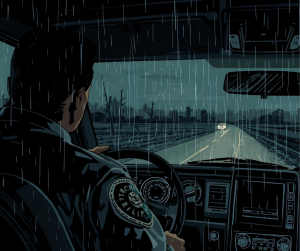 Just after passing what appeared to be a dirt path to my right, I rounded a sharp leftward curve, and my headlights reflected off something metallic and shiny deep into the woods. It seemed out of place, so I decided to investigate.
I backed up to the narrow “path” and turned into what was nothing more than two sloppy-wet parallel ruts carved by automobile tires, likely the tires of a farmer’s vehicle or utility company trucks.
As I inched forward in the slurry, thorny brush scraped along the sides of my car, sounding like fingernails on a chalkboard. Tree branches thumped the rooftop lightbar. Others slapped against the windshield like long, gnarled skeletal fingers giving the glass a series of high-fives.
Just a few yards down the trail, my rear tires began to spin and slip, so I gave the accelerator a shove. The extra power sent globs of goo spewing rearward.
The trek was touch-and-go for a while, with the front end of the car sliding from one side of the path to the other, forcing me to whirl the steering wheel in opposite directions to maintain some sort of straight line of travel. I knew I couldn’t let off the gas, or there I’d sit.
A moment or two later, though, I was through the sloshy goop and on the way toward the source of the reflection, which I soon discovered was a car parked approximately twenty yards off the dirt road in a clear-cut section along a power line, next to a river. I stopped several feet from the vehicle, enough to allow a retreat in case of an ambush. I used my spotlight to examine the car and to sweep the powerful beam across the surrounding area. I also turned on my side alley lights and the bright takedown lights on the front of the lightbar.
The place was nearly as well-lit as a high school football field on Friday night.
There was no sign of anything or anyone, but you never know what danger lies beyond the light’s reach. Again, it was dark and stormy, making it one of those scenarios where the hairs on the back of your neck and arms immediately leap to attention. But I had to forget the woods for the time being and focus on the immediate danger—the car.
I rotated the spotlight and aimed the beam back to the vehicle until I’d zeroed in on the driver’s side. To add to the skin-crawling, heart-pounding, horror movie ambiance, the door was open. However, from my angle, I could see only the outside of the door, leaving the other side and the car’s interior a mystery.
So, despite the downpour, thunder, lightning, and those hyper-vigilant hairs (the cop’s sixth sense was in complete overdrive), I had to get out to investigate. So, I did. Before taking the first step, though, I again scanned the area carefully, this time using my Maglite, the old metal kind, making sure a killer wasn’t waiting in the brush to ambush me to make their escape.
After being as certain as possible that the area was clear, I cautiously moved forward. At the same time, the winds drilled raindrops into my face and against my lemon-yellow vinyl raincoat, the one I usually kept in the trunk of my patrol car just for times like this one.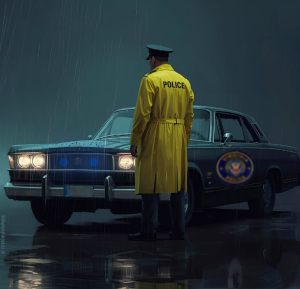 The fury of those gumdrop-sized blobs of water was like that of small stones striking at a pace equal to the rat-a-tat-tatty rounds fired from a Chicago typewriter.
The plastic rain protector I’d placed over my hat worked well at keeping it dry. Still, the rain hitting the covering felt and sounded like hundreds of tiny mallets hammering all at once, as if an all-xylophone symphony decided to perform a complex syncopated piece on the top of my head. At a time when I truly needed the ability to hear a single pin drop, well, it simply wasn’t happening. So, xylophoned, machine-gunned, and gum-dropped from all sides, I slogged onward.
It was a fight to walk headfirst into swirling, stinging winds that tugged and pulled and pushed against my raincoat, sending its tails fluttering and flapping, exposing my brown over tan deputy sheriff uniform. The heavy winter material was not waterproof. Not even close.
The ground surrounding the car was a thick, gooey slop. With each step, my once-shiny brown shoes collected gobs of dense, soggy soil until the weight of my feet felt like a couple of bowling balls.
After making my way around the door, what I saw was shocking, even for a seasoned cop. The body of a young woman lay half-in and half-out of the car, with the outside portion being soaked by the deluge of water falling from the dark sky. Strands of her long hair reached the ground, where they dipped into a puddle, undulating with the back-and-forth motion of the wind-driven water.
Raindrops battered her open eyes, filling the corners until tiny rivers poured down her cheeks, spilling into the muck below.
I couldn’t tell for sure if she was alive or not, but instinct, experience, and the obvious clearly said, “Not.”
These, during a dark and stormy night, were the abysmal conditions in which I met the crying dead woman.
It was one-on-one—me and the victim.
I know, this sounds like a bit of overwriting when describing the setting; however, I wanted you to experience it as I did, and believe me, the feeling that night was, well, over the top. You should know and see in your minds that raindrops the size of gumdrops pelted the victim’s face, gathering and pooling at the corners of her eyes, eventually spilling out across her cheeks like tiny rivers that followed the contours of her flesh until they poured from her in miniature waterfalls.
You should know this because …
She Was a Dead Woman Crying in the Rain
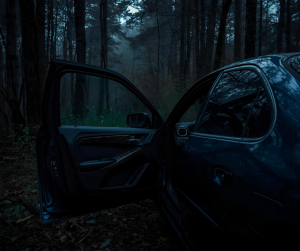
Driver’s door,
Open.
Bottom half in,
Top half out.
Lifeless hand,
Resting in mud,
Palm up.
Face aimed at the sky.
Rain falling,
Mouth open.
Dollar-store shoes,
Half-socks.
Youngest daughter—the seven-year-old,
Called them baby socks.
Her mother’s favorite,
Hers too.
Hair,
Mingled with muck,
And water,
Sticks and leaves.
Power lines,
Overhead.
Crackling,
Buzzing.
Flashlight,
Bright.
Showcasing
Dull, gray eyes.
Alone,
And dead.
A life,
Gone.
Three rounds.
One to the head,
Two to the torso.
Kill shots, all.
Five empty casings,
In the mud.
Pistol.
Not a revolver.
Wine bottle.
Beer cans.
Empty.
Scotch.
“No, we don’t drink. Neither did she. Except on special occasions. Yep, it must have been something or somebody really special for her to drink that stuff.”
“Was there a somebody special?”
Eyes cast downward.
Blushes all around.
“Well … she did stay after Wednesday night preaching a few times. But they were meetings strictly about church business. After all, he is the Pastor. A good man.”
More blushing.
A stammer, or two.
A good man.
The rain comes harder,
Pouring across her cheeks.
Meandering
Through her dark curls.
Droplets hammer hard
Against her open eyes.
Pouring into tiny rivers,
Filling the puddles below.
She doesn’t blink.
Can’t.
She’s a dead woman crying,
In the rain.
Tire tracks.
A second car.
Footprints.
Two sets.
One walking.
Casually?
A sly, stealthy approach?
The other, long strides.
Running, possibly.
Zigzagging toward the woods.
Bullet lodged in a spruce pine.
One round left to find.
Cold water inside my collar, down my back.
Shivering.
Cloth snagged on jagged tree branch.
Plaid shirt.
Blood?
Still visible,
in the rain?
The missing fifth round?
Maglite never fails, even in torrential rain.
Cop’s best friend.
A shoe in the underbrush.
Attached to a man.
Dead.
Bullet in the back.
The fifth round.
Coming together, nicely.
Church meetings.
Pastor.
Two lovers.
A special wine for a special occasion …
A good man.
Sure he is.
Police car,
Parks at curb.
Morning sunshine.
Tiny face,
Peering from window.
Waiting for Mama.

Scent of frying bacon in the air.
Door swings open.
Worried husband.
“No, she didn’t come home after church. Called friends and family. Nobody knows.”
Husband, devastated.
Children crying.
“Yes, I have news.
And I’m so sorry for your loss.”
Tire tracks match.
Pistol found.
Pastor,
Hangs his head in shame.
Special occasion.
To profess love.
But …
Another man.
A second lover.
Anger.
Jealousy.
Revenge.
Handcuffs.
Click, click.
Murder’s the charge.
No bond.
Single, unique plant seed,
Stuck to the brake pedal.
The single bit of evidence,
That tied him to the scene.
Got him.
Prison.
Life.
No parole.
A “good man”, a preacher, left the little girl’s mama to cry in the rain, wearing baby socks.
Today, decades later, raindrops squiggle and worm their way down the panes of my office windows.
And, as it often happens on rainy days,
I think of the crying dead woman.
Of her kids,
Her loving husband,
And,
Of course,
Baby socks.